
On Things that Fade
The thing is no matter how tightly I cling to the flowers, they still wither.

I wasn’t intending to write this essay.
I am sitting at my desk. It is late in the morning. The sky is turning that bright, weightless blue that only appears for a few minutes before noon. I have tea in my cup. Jasmine flavored. Slightly cold now. The vase in front of me still hold the roses from last Sunday. I had done everything I could to keep them alive: trimmed the stems diagonally, changed the water twice a day, added sugar and aspirin like some kind of ritual. A way of bargaining with time.
They are still beautiful, but in that sad, crisp way flowers get when they begin to dry from the edges inward. I don’t know why it always surprises me. It’s not like I don’t know how this ends.
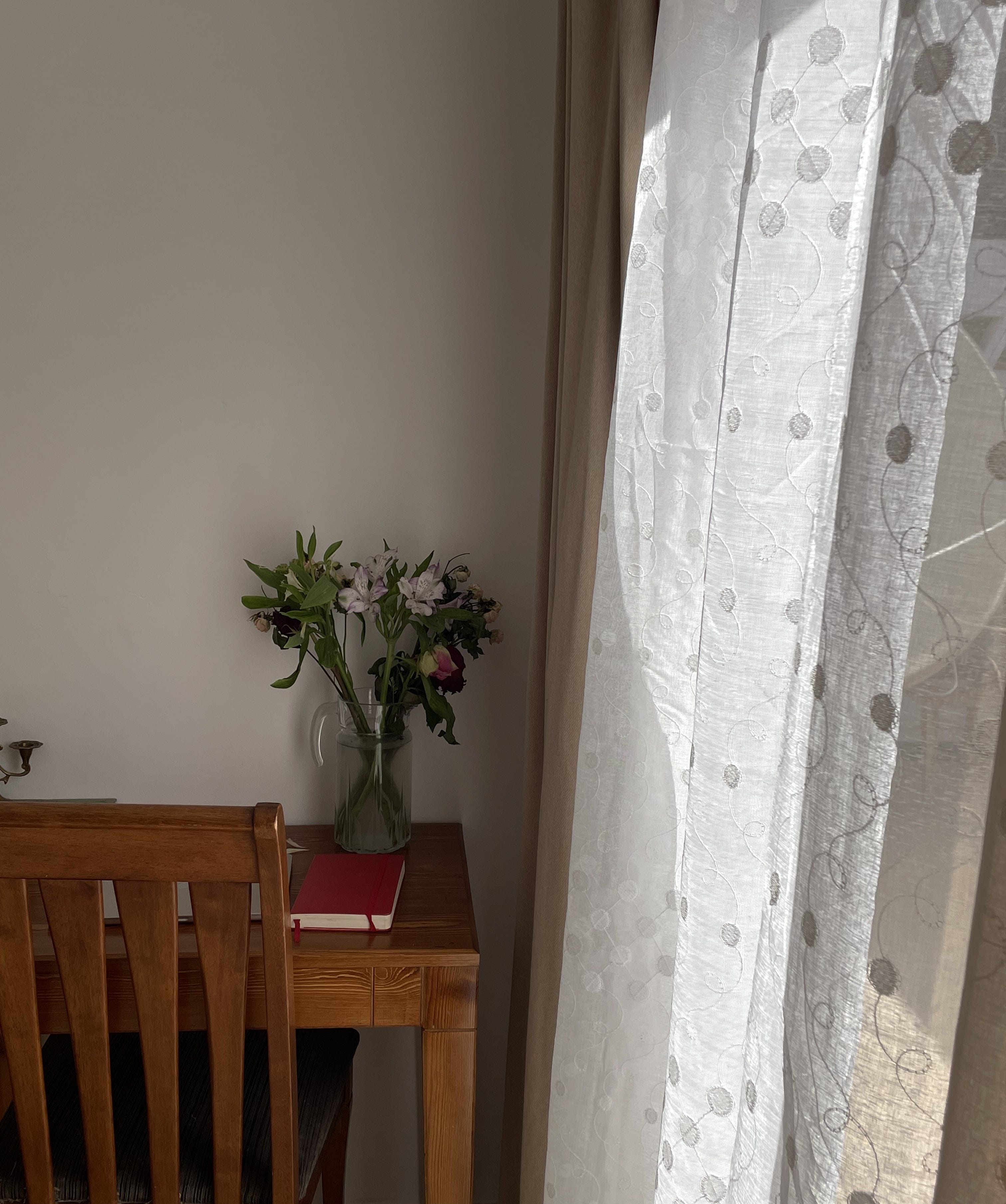
I have been looking at them for a while. Not out of grief, but out of something else. Recognition, maybe. The pulse of writing came suddenly. I didn’t plan it. I never do. It always arrives uninvited, like memory, like grief. And when it comes, I follow.
What struck me was not just the dying of the flowers, but the way they were dying: with grace, with silence, with something that looked like surrender. Something I am still trying to learn. Why do I try so hard to stop the natural course of events. How many small, invisible acts I had performed to delay the fade. There’s something in me, and I think in many of us, that can’t help but try to hold on, even when we know. Even when we know.
There is something sublime, almost unbearable, about watching things fade. And this is where I always return to Edmund Burke, who said that the sublime is found not in beauty alone, but in beauty touched by terror, in vastness, in awe, in the feeling of standing before something that exceeds us. For him, the sublime was not soft. It was a kind of trembling. And maybe that’s what I felt looking at the flowers, not sadness, exactly, but trembling. Because they reminded me of how everything slips away. Not in a dramatic way. Not even in a loud one. Just… eventually.
There was another time, months ago, when I was rearranging the shelves in my room and I found a crumpled receipt from a restaurant. I had forgotten I kept it. The ink was slightly faded. But as soon as I saw the name, the time, the title printed total I remembered. The way I sat near the window, pretending to read but really just watching people walk by. I don’t know why I kept the ticket. Maybe I thought it mattered. Maybe I wanted proof that I was there. I sat down on the floor and held it for a moment. I wanted to feel what it was like to be that version of myself.
And I thought of the idea of the punctum of Roland Barthes, that sharp point in a photograph that wounds us. The part that pierces through and reminds us of what’s no longer there. In Camera Lucida, he writes:
“The photograph is literally an emanation of the referent. From a real body, which was there, proceed radiations which ultimately touch me.”
The flowers, too, feel like that. Radiations from a fragment that was. The receipt. The restaurant. The people we no longer speak to but still carry in our gestures.
And it’s strange, how often we live like we can outsmart time.
We record voice notes, write down memories, press flowers in books, take pictures, keep old T-shirts. We do this knowing full well that none of it will bring back what has passed. But maybe that’s not the point. Maybe the point is the act itself: to try. To love so hard we can’t help but leave traces.
Sometimes I wonder if that’s what makes us human, our stubborn refusal to let go easily. Our quiet rituals. The sugar in the water. The receipts we don’t throw away. The essay I wasn’t planning to write.
The thing is, everything will fade. I know this. I’ve always known.
And yet I choose to stay soft.
I choose to keep watering the flowers.
And maybe that’s the most beautiful thing about us.
Not our ability to hold on,
but our willingness to love
even as we let go.
i love this buthaina 🥺🤍 every time i get a bouquet of flowers i feel i have to photograph them before they die in order to preserve them and their beauty in some way, to memorialise the fact i had them for a few days. at times, i’ve wondered if it’s futile or even silly, but your beautiful words have reminded me of the importance of simply trying xxx
I must say you write very beautifully. I couldn't help but think about the very famous "Beauty is terror" while reading your article. Also, I found it very poetic, the notion of rituals to kind of stop the time from escaping us. We know we can't but we do it anyway.
Thank you for your words.